


Talkin’ ‘Bout My Generation: Office Co-Existence
It’s the proverbial narrative we’ve all heard before: Baby Boomers and Gen X thrive on the nine to five, while Millennials and the emerging Gen Z can’t help but shake up conventional office cultures. From an increased interest in work-life balance to collaborative layouts, high-tech upgrades, and hybrid arrangements, these new generations have pushed the traditional workplace into a modern era. And while these realities existed long before COVID-19, the pandemic brought changing needs and preferences to light. Companies had to quickly pivot to accommodate remote work; but as life gets back to normal, employers are now seeking ways to entice people of all ages back to the office. Workplace redesign is top of mind.
Generational Preferences
As designers map out plans for renewed office spaces, an obvious question comes to mind: do proclivities differ across generations?
The research is clear. For Baby Boomers, born between 1946 and 1964, the concept of the corporate ladder meant that employees typically remained faithful to one employer over the course of their careers, seeking opportunities for advancement through tried-and-true displays of a hard work ethic, such as daily on-site visibility and long hours, including overtime. Entering the workforce in the 1960s, ‘70s and ‘80s, Baby Boomers became accustomed to offices that favoured space-saving cubicles, large corner offices for executives, cookie-cutter conference rooms, and kitchens that doubled as social spaces during morning coffee and lunchtime hours.
Gen X was not far behind. Born between 1965 and 1980, these individuals are typically just as independent and hard working as Baby Boomers, albeit more technologically adept and prone to embracing opportunities for career advancement wherever they present themselves. For Millennials, the same rings true, although this group, born between 1981 and 1997, tend to value employers that encourage personal and professional development, as well as collaboration and a strong sense of workplace culture. The influence of Millennials can be seen in the fun, functional, and forward-thinking designs of many offices pre-pandemic, like Shopify’s Ottawa and Montréal headquarters, where themed meeting spaces, indoor go-kart tracks, colourful game rooms, and cafés demonstrated a clear shift from the drab office spaces occupied by generations prior.
The youngest generation, Gen Z, is arguably the most intriguing to today’s employers. Born between 1998 and 2010, these individuals will comprise 50 per cent of the total global workforce by 2025, and in order to attract and retain talent within this bracket, companies are transforming their offerings, from greater opportunities for mentorship and face-to-face interaction to completely reimagined hybrid workplaces. Highly researched and surveyed, this generation has, on average, expressed an interest in authenticity and intentionality, both in workplace culture and office design; and according to research conducted by the global design brand Steelcase, Gen Zers surprisingly work in the office more than any other generation. They understand and appreciate the benefits of remote work, but simultaneously crave on-site experiences as well.
The Destination Workplace
So how have these generational preferences influenced post-pandemic office paradigms? And are employees of different age groups comfortably co-existing in these settings?
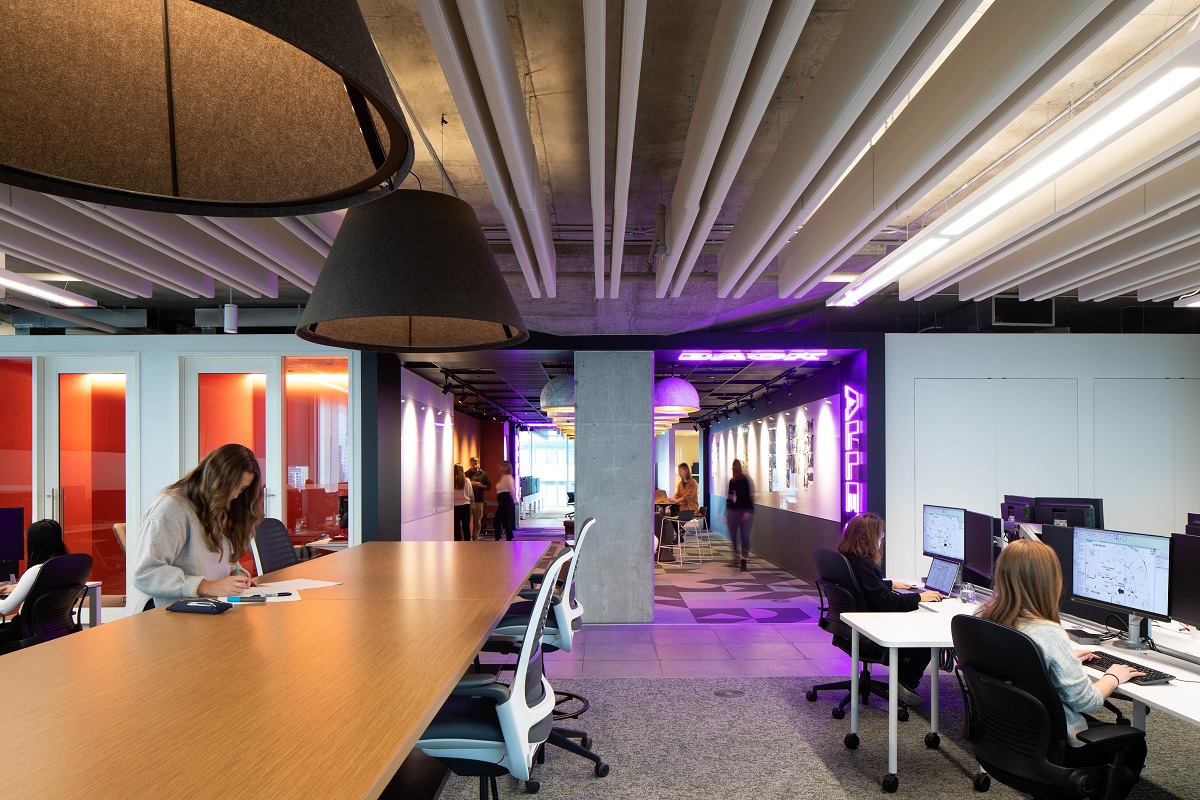
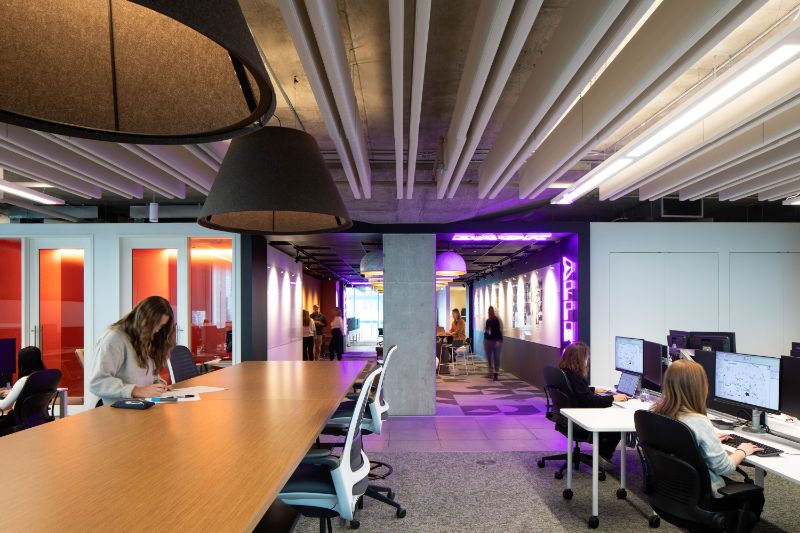
To better understand their varied personnel, companies are undertaking research to tap into their employees’ wants and needs. In Toronto, BDP Quadrangle’s new two-storey studio at Front St. and Spadina Ave. is a case in point. After outgrowing its previous office space on King Street, the firm saw an opportunity to improve its office culture by embracing a bigger, more modern space: a “destination workplace” that would inspire employees to come back together at the office, with a fresh design that would meet their present-day needs. “We were bursting at the seams,” said Caroline Robbie, principal at BDP Quadrangle. “There was no sense of community to the firm anymore.”
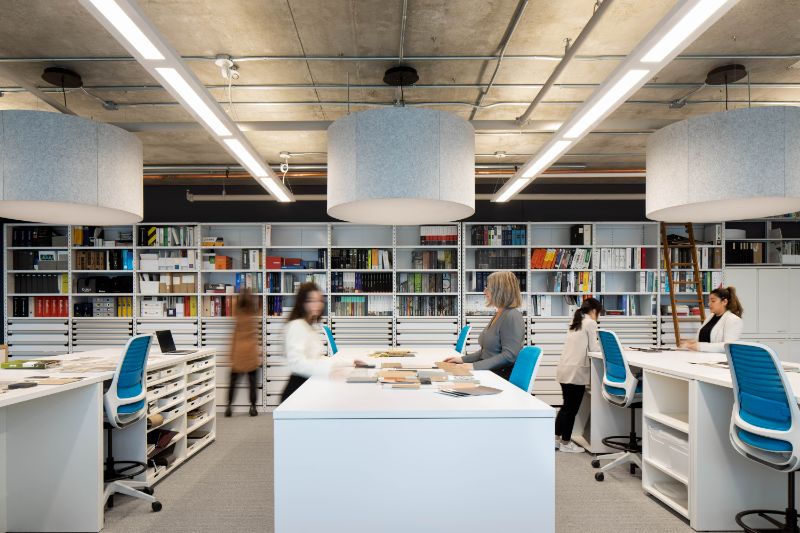
The team embarked on an eight-month period of internal engagement and data research, consisting of employee surveys, management retreats, town halls, site visits, group charrettes and more. The goal was to learn more about what employees of all ages wanted out of their new office space which, conveniently, would be located within The Well, a mixed-use office, retail, living and dining complex with spaces already designed by BDP. “Before we put pen to paper, we looked inward at our company: what we had done historically, what happened at the onset of COVID, and where we could go with it,” said Andrea McCann, associate and lead interior designer on the new studio project. “We never came to a conclusion of ‘one size fits all.’ Everybody wants something different, and that was our key to the spaces. Every area needed to perform double or triple duty, and there had to be a space for everybody.”
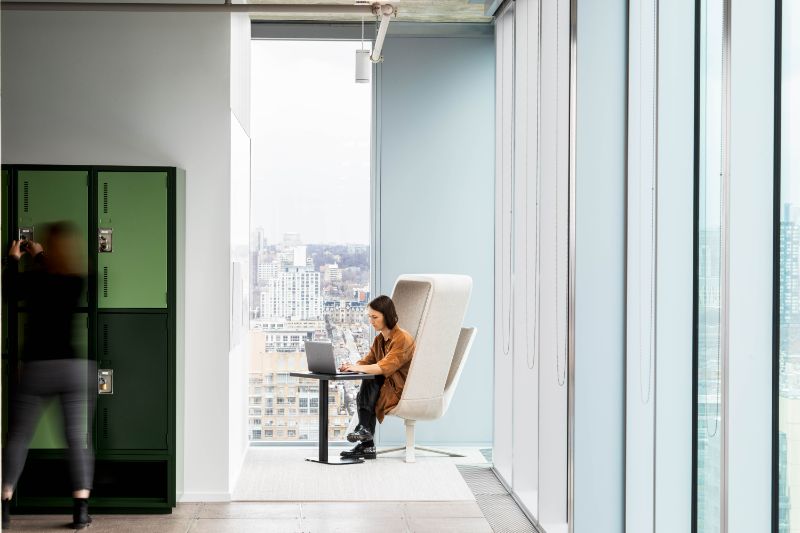
The solution was workplace neighbourhoods: seven individual studio spaces, each with unique offerings, that would encourage either collaborative or independent work. “We weren’t thinking, ‘this is going to be a nice area where a Boomer or Gen X is going to be most comfortable,’” said Robbie. “It was more about ‘are we providing the right variety? Do people have enough choices?’”
In the Oasis neighbourhood, for example, users are treated to a Zen zone complete with plants, soft furnishings, ample natural light, and clear views of the CN Tower, Financial District, Fort York, and Lake Ontario. “It feels like an updated Victorian conservatory. You’re in a beautiful glass box,” said Robbie. “This is where you come when you need a little bit of inspiration and some restoration.” In contrast stands the Black Box neighbourhood, where a lack of colour and visual distraction encourage deep work and focused discussion.
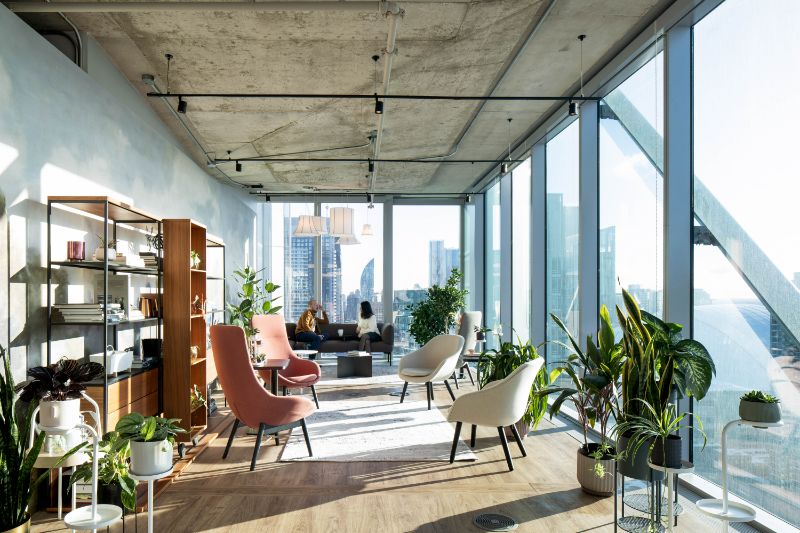
Sustainability and accessibility were also integrated throughout the design, surpassing provincial accessibility regulations and pushing the firm closer towards meeting its 2025 net carbon neutral goal.
Human-Centered Approach
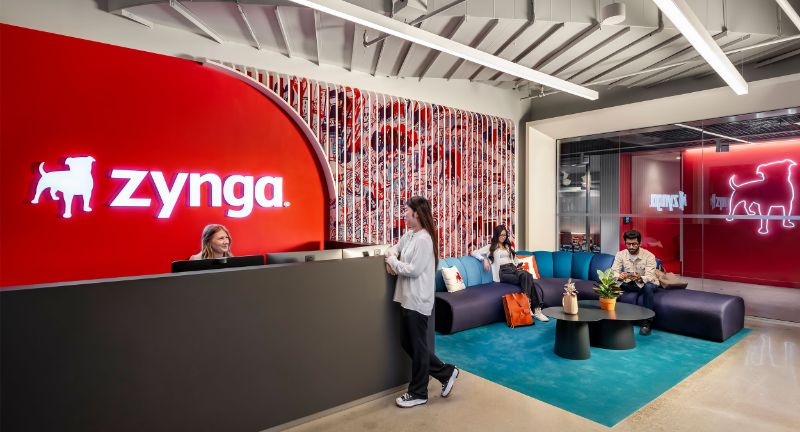
Two blocks over, inside Toronto’s historic CBC building, the Toronto office of M Moser Architects (a global firm headquartered in Hong Kong with 28 offices internationally) recently designed a new head office for the video game developer, Zynga. Mandated to salvage and repurpose as much of the existing infrastructure as possible, the design team undertook planning exercises to assess how they could maximize the existing partitions, meeting rooms, furniture and spaces, to limit the amount of architectural intervention while still supporting Zynga’s brand.
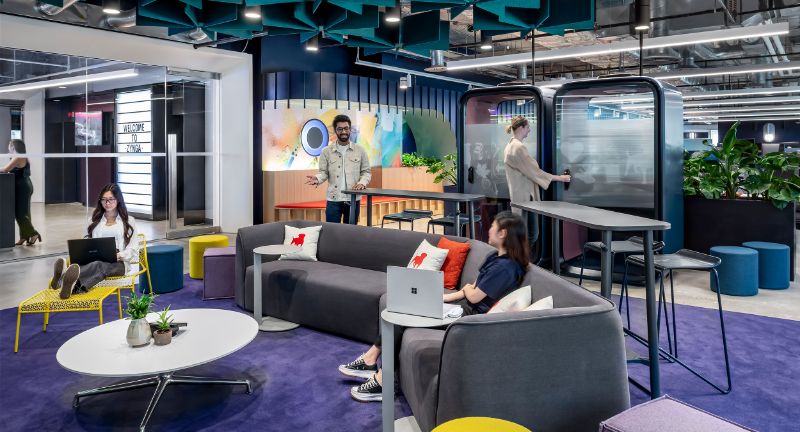
The same planning exercises were used to study the behaviours of employees, and, like BDP Quadrangle, design neighbourhoods to support them. The Moser team similarly found no division or set preferences among generations, but instead, unique needs among employees of all ages that varied day by day.

“At Zynga, there’s a shared experience that spans multi-generations. When you look at their workflows, it’s very agile and collaborative, but there are unique needs within those groups that we wanted to cater to,” said Chantal Frenette, director at M Moser Architects. “Everybody needs to focus; we all just focus differently. Everybody needs to collaborate; we may just collaborate differently. So, by giving choice to people, you’re not boxing anyone into a certain type of work setting.”
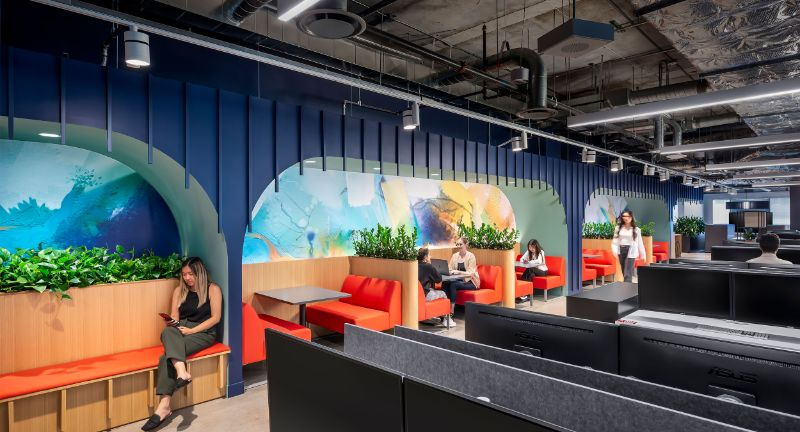
In addition to building AV into every corner of the multi-level office in support of remote connectivity and hybrid work, the Moser team embraced colour to establish moods and support behaviours in each space: orange for energy; yellow for playfulness; red for stimulation; blue for focus and so on.
Local art was also incorporated throughout the office for stimulation and inspiration, while toned down spaces were designed to support concentration and quiet contemplation. “We needed to think of the unique needs of people who might be more introverted, or maybe have anxiety about coming into work, or maybe have challenges focusing, or might be neurodivergent,” said Frenette. “It’s a very human-centered approach.”
The Takeaway
While generational stereotypes certainly exist and, to some degree, continue to ring true, when it comes to post-pandemic office design, companies will not succeed by typecasting employees into clear-cut age groups, nor by assuming that these individuals cannot easily co-exist. “That’s the takeaway,” said Robbie. “Generational clichés should not be applying at all anymore, because let’s face it, we’re living through a seismic change in workplace thinking that hasn’t happened since the 1960s.”
Instead, the key to drawing people of all ages back to the office, and to encouraging a shared experience, is through a variety of thoughtfully planned and inspiring spaces. “We don’t look at it from a generational perspective or a demographic perspective,” said Frenette. “It comes down to the culture of that organization. It comes down to what they want to achieve.”
With a focus on community and ample opportunities for independent and collaborative work, companies can support their own corporate endeavours and those of the unique individuals they engage. As Caroline Robbie said, “People aren’t going to love where they work if they don’t feel that it’s got something of them in it.”
Photography:
- Adrien Williams (BDP Quadrangle)
- Gillian Jackson (Zynga)