



Safe Keeping: The Summit Marian & Jim Sinneave Centre for Youth Resilience
When SAHURI Partners + Architecture was tasked with designing a new mental health facility for children and adolescents in northwest Calgary, a priority was the development and execution of a thoughtful research phase. The $39-million, 34,000-sq.ft. facility — known as The Summit: Marian & Jim Sinneave Centre for Youth Resilience — would soon become the city’s first pediatric mental health hospital, targeted specifically to the treatment and care of some 8,000 children and teens annually.

The team at SAHURI, in partnership with Alberta Health Services and the Alberta Children’s Hospital Foundation, first consulted local families, mental health professionals, and members of dedicated Youth and Family Advisory Committees, to learn more about pressing issues affecting youth today, and to develop design solutions that would support their wants and needs. Among their findings was a strong desire for a facility that would support hospital-level care without a typical institutional feel.
“Public participation was an integral part of the design and operations of The Summit,” says Tim Sahuri, founding principal and executive architect at SAHURI Partners + Architecture. “Feedback was vigorous. For example, participants told us in no uncertain terms that they didn’t like terrazzo floor tiles or ceiling tiles because it made the interiors look too institutional.”

A safe, comfortable and inviting space that promotes healing was achieved through wood-clad and patterned ceilings, colourful walls and furnishings, ample large windows for natural light, and geometric artificial lighting conceived by SMP Engineering.
Outside, the SAHURI team employed an origami-inspired façade, with building planes folded and triangulated to create a layering effect. Clad in a calming sky blue with wood soffits, gray accents, and a residential-style pitched roof, the exterior attempts to avoid an intimidating first impression for visitors. “The overall goal was to create a building that did not look like a hospital, with abundant visual interest, and utilize a more sophisticated palette as favoured by the youth advisors,” says Sahuri.
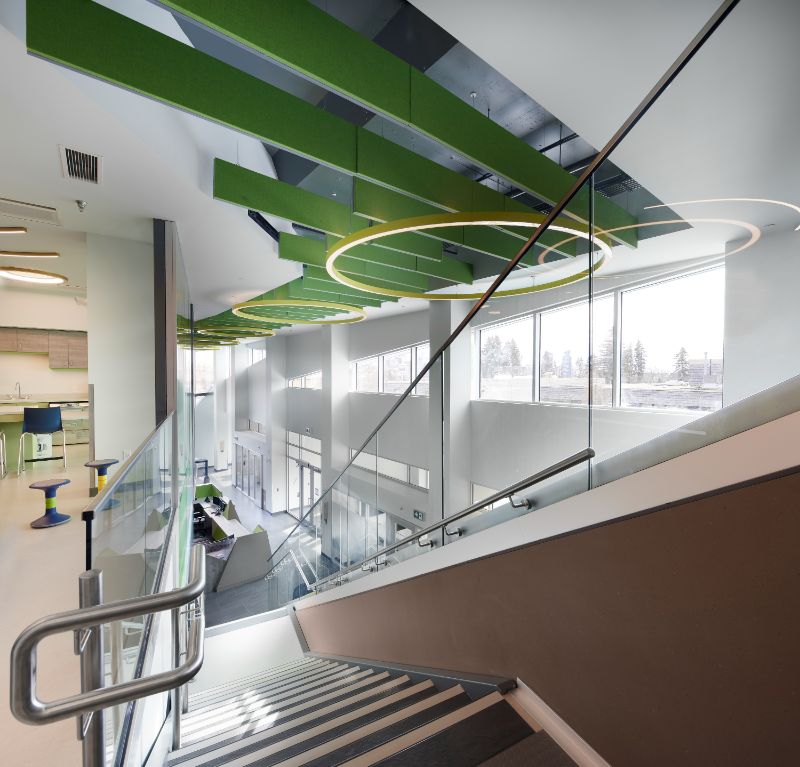
Copious greenery, therapy gardens, and adjacent park spaces ensure a connection with nature, while a high-performance building envelope and passive systems add to the sustainability and efficiency of the LEED Silver Certified facility.
The need for a dedicated youth mental health facility in Calgary — and in other cities across the country — is clear. Research shows that approximately 1.2 million Canadian children and youth are affected by mental illness, and among the adult population, 70 per cent of issues reportedly develop during their juvenile years. What’s more, according to Mental Health Research Canada, only 16 per cent of youth under 20 accessed mental health services in the last year.
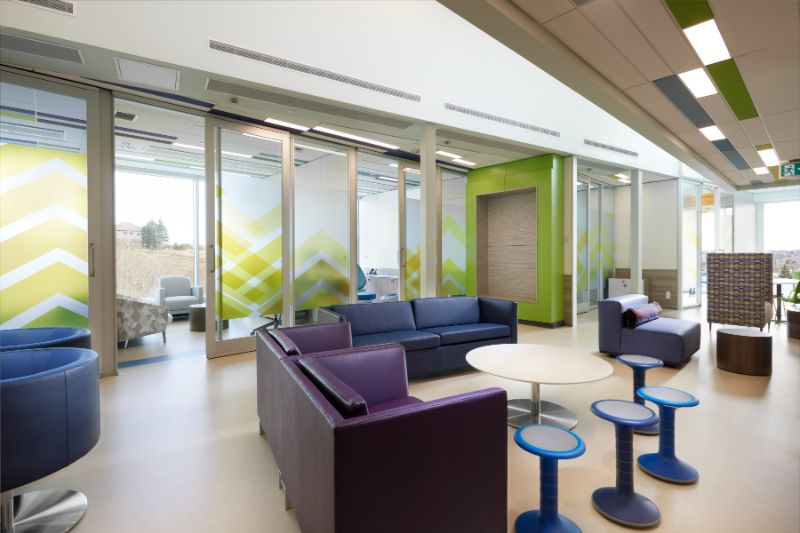
The Summit aims to tackle these stats. Integrated throughout the three-storey facility are programs including free walk-in therapy sessions, a treatment centre aimed at preventing or reducing the need for hospitalization, and a mental health day hospital for those not requiring overnight admission. These programs were developed in part by SAHURI through additional research obtained when touring 15 mental health facilities across Australia, Canada and the United States.
“A takeaway from the tours is that the Summit is doing something unique in this space,” says Sahuri. “While there were similarities between the proposed program and the places that were toured, combining the walk-in, community-based services, as well as the day hospital, really hasn’t been done. This unparalleled depth of knowledge allowed us to develop a state-of-the-art facility.”

In addition to benefiting from $50 million in construction fundraising, the facility will see continued annual support from the Government of Alberta, as well as mental health research advancements through a partnership with the University of Calgary. For its users, “the Summit will be a place to find answers, healing and a fresh start,” says Sahuri, “all while improving mental health treatment for the next person who walks through the front door.”