



More challenges ahead for global furniture sector: Report

The end-of-the-year edition of CSIL‘s “World Furniture Outlook” report is confirming challenging times for the furniture industry affected by the global geopolitical climate of uncertainty.
The report, called World Furniture Outlook 2025 , analyzes the global furniture sector and provides insights into furniture market trends, historical series of basic data, macroeconomic indicators, and prospects of the furniture market. The study also highlights regional dynamics and provides data for 100 countries for the years 2025 and 2026.
While CSIL’s preliminary figures for 2024 show a slight increase in world furniture trade, future prospects are negatively impacted by the protectionist agenda of the new U.S. administration.
In 2024, more than half of global furniture production is expected to take place in Asia and the Pacific, with China being the leading producer. On the global scale, about 40 per cent of production is exported.
The report noted that China remains the top furniture exporter, accounting for more than a third of total exports, followed at a distance by Vietnam, Poland, Italy, and Germany. Global furniture production in 2024 also amounts to a total of $ 471 billon USD, the same as 2023, below 2022.
While there has been some gradual improvement in supply chain operations and pricing dynamics within the sector, the situation is still “far from fully normalized,” according to CSIL. The geopolitical climate also continues to create significant uncertainty on the global stage.
Following a rise in 2021, China’s furniture exports decreased significantly in 2022 and 2023. Preliminary data for 2024 indicates a gradual recovery in Chinese furniture exports.
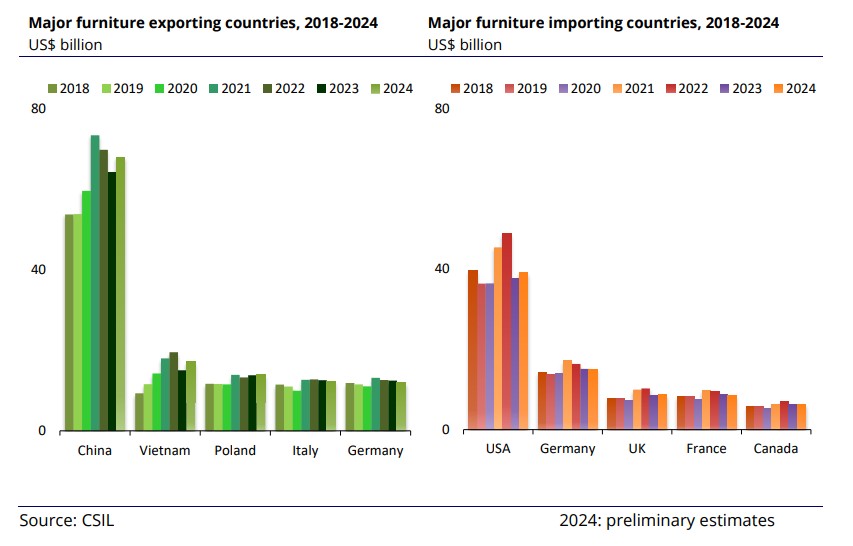
The leading importers of furniture are the United States, Germany, the United Kingdom, France and Canada. Together, these countries account for almost one half of total imports.
Following the decrease in 2023, preliminary data for 2024 indicates a modest increase in U.S. furniture imports. The situation in Europe, however, is quite different.
A sizeable percentage of international furniture trade is carried out within the economic regions into which the world economy can be divided. In the European Union (27) plus UK, Norway, Switzerland and Iceland, about three-quarters of foreign furniture trade takes place within the same region. There are lower, but increasing, percentages of trade within Asia and North America. Trade within regions amounts to roughly 60 per cent of total world furniture trade, which is growing in comparison to recent years.
The report noted that this is possible due to the emergence of near-sourcing policies and that the trend could become even more pronounced if protectionist measures are introduced.
The CSIL ‘‘World Furniture Outlook 2025’’ report, issued in November 2024, assumes that the international scenario will be as follows.
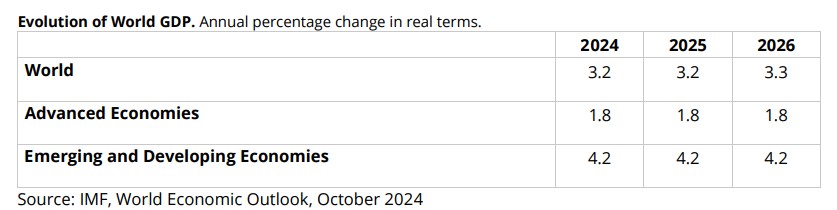
World GDP growth is expected to be 3.2 both in 2024 and in 2025 and 3.3 in 2026, with emerging and developing economies growing much faster than advanced economies. Downside risks come from the concern about an escalation in regional conflicts, and a possible further slowdown of China’s economic growth, growing geopolitical tensions and uncertainties in economic policy decisions, with the potential rise in protectionist measures.
Overall, the various challenges impacting global economies have affected the furniture sector, and have influenced both international trade and local markets. Furniture consumption is expected to increase by 1.4 per cent in 2025 in real terms.
To view the full report, click here.