



Kitchen furniture market experienced substantial decline: CSIL
The latest edition of CSIL’s “Kitchen Furniture Market in North America” report has indicated that the kitchen furniture market in the region had experienced a “substantial decline” in both market value and volume in 2023 and 2024.
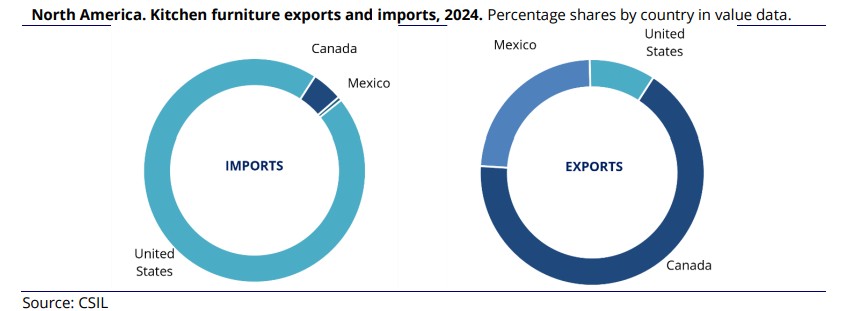
With a value exceeding USD$20 billion, the kitchen furniture market in North America represents over one-third of the sector’s global demand. Canada, however, is the leading exporter in the area.
The U.S. is the largest importer in the world with a USD$2.6 billion negative trade balance. Canada and Mexico, on the other hand, are net exporters with a positive trade balance that improved over the last few years. Both markets are strongly linked to the U.S. as it represents 99 per cent and almost 100 per cent of export destinations respectively.
The largest kitchen furniture groups are located in the U.S. and have presence in both Canada and Mexico. While the competitive landscape is different depending on the country, the market shows signs of concentration as the M&A activities continued over the last few years.
In the U.S., over 60 per cent of the market is in the hands of the top 10 players in Canada and Mexico. In 2023 and 2024, the U.S. construction market faced challenges, particularly in the housing sector, with builders accounting for a portion of the kitchen furniture business.
In Canada, home builders represent a prominent distribution channel, as houses and apartments for sale or rent typically include kitchens. The relevant growth of residential investments and the new building construction in Mexico is also sustaining the kitchen furniture business.
According to CSIL, market prospects for the next two years are positive, though the global outlook is expected to remain stable. An intensification of protectionist policies, however, in the form of a new wave of tariffs, could exacerbate trade tensions, lower investment, reduce market efficiency, distort trade flows, and disrupt supply chains. Growth could also suffer in both the near and medium term, but at varying degrees across economies.