


Process, not outcome, is explored at Complètement Design in Montréal
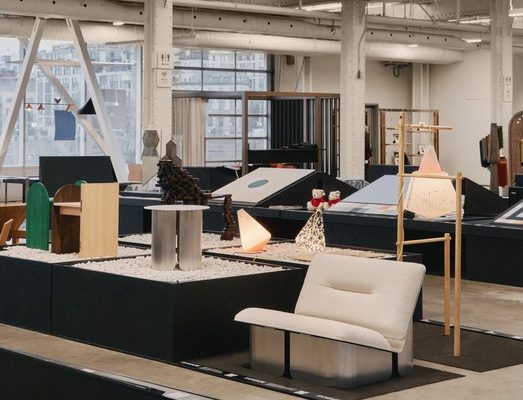
In April, the third edition of Complètement Design took over both floors of the Grand Quay in Montréal’s Old Port. Over 40,000 square feet spread across two vast industrial halls served as the area for a scenography designed by Montreal-based Ivy Studio and seen by 2,000 visitors.

In record-breaking installation time, the scenography team were able to reuse existing materials with a bold spatial reimagining, aligned with the 2025 central theme, called Generative Generation – Design in Process, and which celebrated what is usually hidden such as sketches, mistakes, raw materials, and first intentions. By placing the process at the heart of the experience, the event celebrated an emerging aesthetic: a living, evolving design, often perceived as unfinished.
On the ground floor, visitors were welcomed by a reception area and a café-bar. Three curved translucent Tyvek walls filtered the light and space, revealing the event’s core, which was a horizontal exhibition hall with almost 80 exhibitors. Toward the back, a secondary stage hosted informal talks. There was also a pop-up shop, curated in line with the annual theme and featuring art books and locally made objects.
Upstairs, there was a 400-seat conference hall hosting a lineup of presentations by local and international design figures, including Matali Crasset, Michel Dallaire, Harry Nuriev, Sonia Gagné, and Christopher Dessus. On the opposite side, a concept restaurant offered a culinary experience. Between the two, a linear gallery presented a series of art installations and a video projection tied to the annual theme.

At the restaurant, a communal table occupied the room’s centre and was surrounded by a collection of chairs by local designers. Each piece was presented in its raw state: exposed joints, visible materials, and unfinished surfaces. Illustrated menus on the table described each chair, its designer, and its making story.
At the heart of the space, an installation by Studio Sveja blended foam, soil, and mesh to create a circular landscape dominated by a sculptural, plant-covered chair. Nearby, Galagog, a light fixture by Gim Bert, along with its imposing mold, stood over the restaurant’s counters.
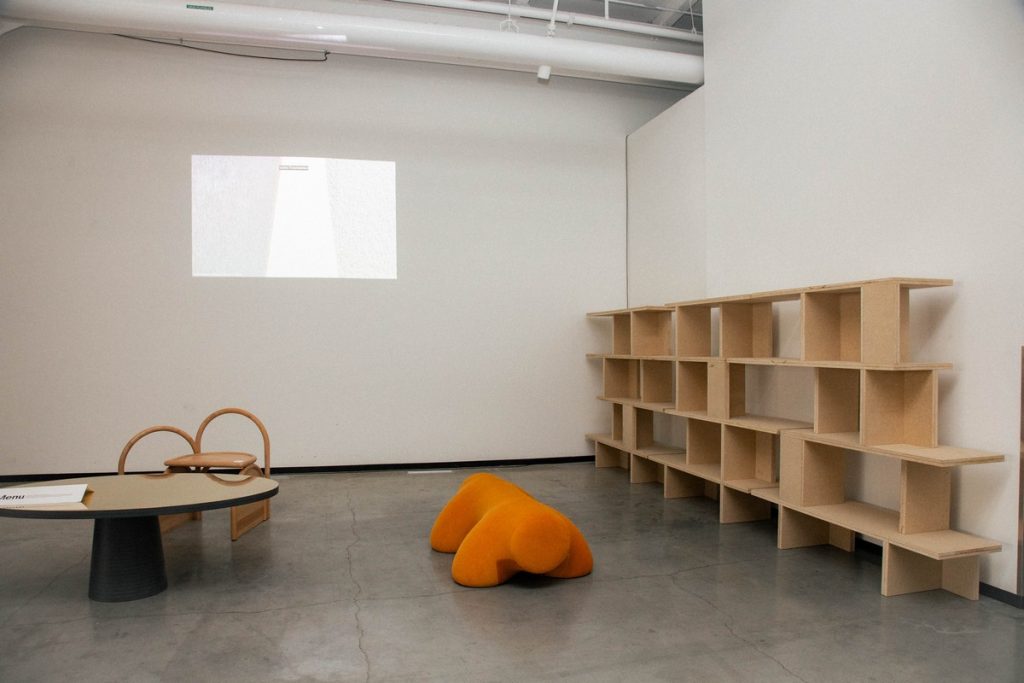
A prototype lounge showcased furniture in the exploratory phase such as the VM02 sofa by Ivy Studio, the Brass et Patina table and a chair by L’Autre Atelier, the Tom bench by Reggy St-Surin, and a shelf prototype by Quinlan Osborne for Claste Collection.

In the main hall, artist Delphine Huguet suspended colourful silks across the frame of an unfinished wall, adding a tactile softness to the construction language. The Canadian collective Double Entendre also exhibited a series of one-of-a-kind objects, each revealing its own process through intentionally exposed details, challenging the constraints of standardized production methods.
L’emploi du temps, a video projection by Thomas Balaban, featured Québec-based designers exploring generative AI. The work highlighted creations inspired by ambiguity, reinvention, and the unexpected; a balance between unpredictability and intention.
The scenography embraced a raw, transitional, and functional aesthetic. Freestanding walls made of raw wood and covered in construction-grade Tyvek divided the spaces while letting light filter through. Their materiality underlined the temporary nature of the intervention, designed to be reused on future building sites. Some walls guided circulation, while others served as supports for signage or creative expression.
Furniture reused from previous editions was reimagined into new configurations. Rectangular modules, combined with new black tabletops, became exhibition tables. Other modules formed counter fronts or benches.
Echoing the central theme, each exhibitor incorporated a square mirror, object, or material fragment symbolizing a reflection of their creative process or approach into their space.
Complètement Design 2025
Index-Design, producer
Tafisa Canada, Official Presenting Partner
Ivy Studio, partner firm for scenography
Neolith + Ciot, program presenter
Principal, campaign partner
Conception, installation and scenography:
Philip Staszewski, Vincent Maillé, Sandra Zimmermann, Gabrielle Rousseau, Guillaume B Riel, David Kirouac et Jérémi Brodeur, Ivy Studio. Sandra Heintz, Géraldine Cadeau, Claire Denèle, Index-Design.