



Economic uncertainties pose challenges for global furniture sector: CSIL

CSIL’s latest “World Furniture Outlook” report for 2025/2026 has confirmed that challenging times are still ahead for the furniture industry, which is currently being affected by economic, social, and political uncertainties.
In the past 10 years, international trade in furniture has expanded at a faster pace than global furniture production, accounting for around one per cent of total international trade in manufactured goods.
By 2019, the sector’s trade value had reached approximately $151 billion USD. In 2020, the outbreak of the pandemic brought this trend to a halt, which resulted in stagnation. The year 2021 marked a period of robust recovery and strong growth, only to be followed by another year of stagnation in 2022.
The report noted that the year 2023 proved to be challenging for the global furniture trade, which contracted by 9 per cent in current U.S. dollar terms, despite the inflationary context. Data for 2024 indicated a modest recovery, with the value of international furniture trade rising slightly in current U.S. dollars to reach US$ 178 billion.
When it comes to the outlook for global trade, it has deteriorated due to a surge in tariffs and trade policy uncertainty. In recent months, tariffs have been announced, suspended, renegotiated, reintroduced, and suspended again. In this ever-changing environment, it is not only the tariffs, but also the uncertainty they generate that weighs on global trade and investment decisions.
The report noted that future prospects are negatively affected by the “protectionist agenda” of the new U.S. administration, and that a decrease in world trade of furniture is expected this year.
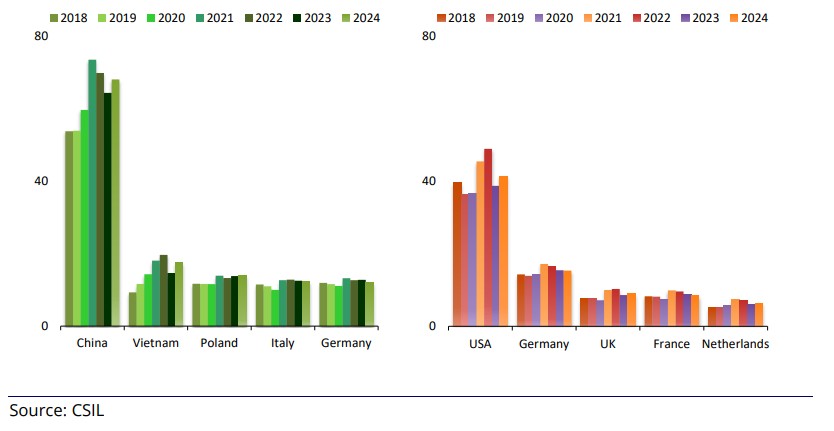 The main furniture exporting country is China, followed by Vietnam, Poland, Italy, and Germany. After a major increase in 2021, China’s exports decreased in 2022 and 2023, with a partial recovery in 2024.
The leading furniture importers are the United States, Germany, the United Kingdom, France, and the Netherlands. U.S. furniture imports amounted to US$ 41 billion in 2024, which represents roughly one quarter of global imports.
Out of the 100 countries analysed, 24 list the United States as their primary export destination. Among these, 10 countries export over 50 per cent of their total furniture shipments to the U.S. market.
Uncertainty in international trade policies could potentially push countries to diversify their export markets, and, in particular, the disruption in U.S.-China trade is likely to lead to substantial trade diversion, prompting concerns in third-party markets about heightened competition from Chinese exports.
The CSIL ‘‘World Furniture Outlook 2025/2026’’ report, issued in June 2025, assumes that the international scenario will be as follows.
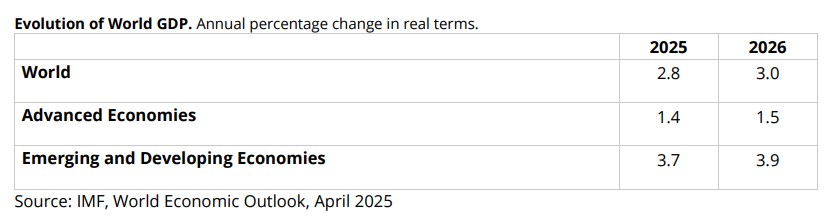 World GDP growth is expected to decline from an estimated 3.3 percent in 2024 to 2.8 percent in 2025, prior to rebounding to 3 percent in 2026.
These projections represent downward revisions in comparison to earlier forecasts. The widespread downgrades across countries are primarily due to the direct impact of new trade measures, and their indirect effects due to increased uncertainty, and weakening economic sentiment.
Reduced household purchasing power as a result of high inflation and interest rates, tightening financing conditions, and uncertainties in the economic, social and political context have affected furniture consumption in 2023 and 2024.
In 2024, furniture consumption in current U.S. dollars returned to almost the same level as in 2019. For the world as a whole, or a total of 100 countries, furniture consumption is expected to remain unchanged in real terms this year, with a modest improvement in 2026.
International trade of furniture is in a state of unprecedented uncertainty, and trade policy and tariff unpredictability may continue. As a consequence, the report advises that forecasts on consumption and international trade of furniture should be used with “great caution,” particularly for countries where the furniture sector is more open to international trade.
Continuing uncertainty adversely affects the business climate for the furniture sector, particularly regarding investment decisions and household consumption behaviour.