


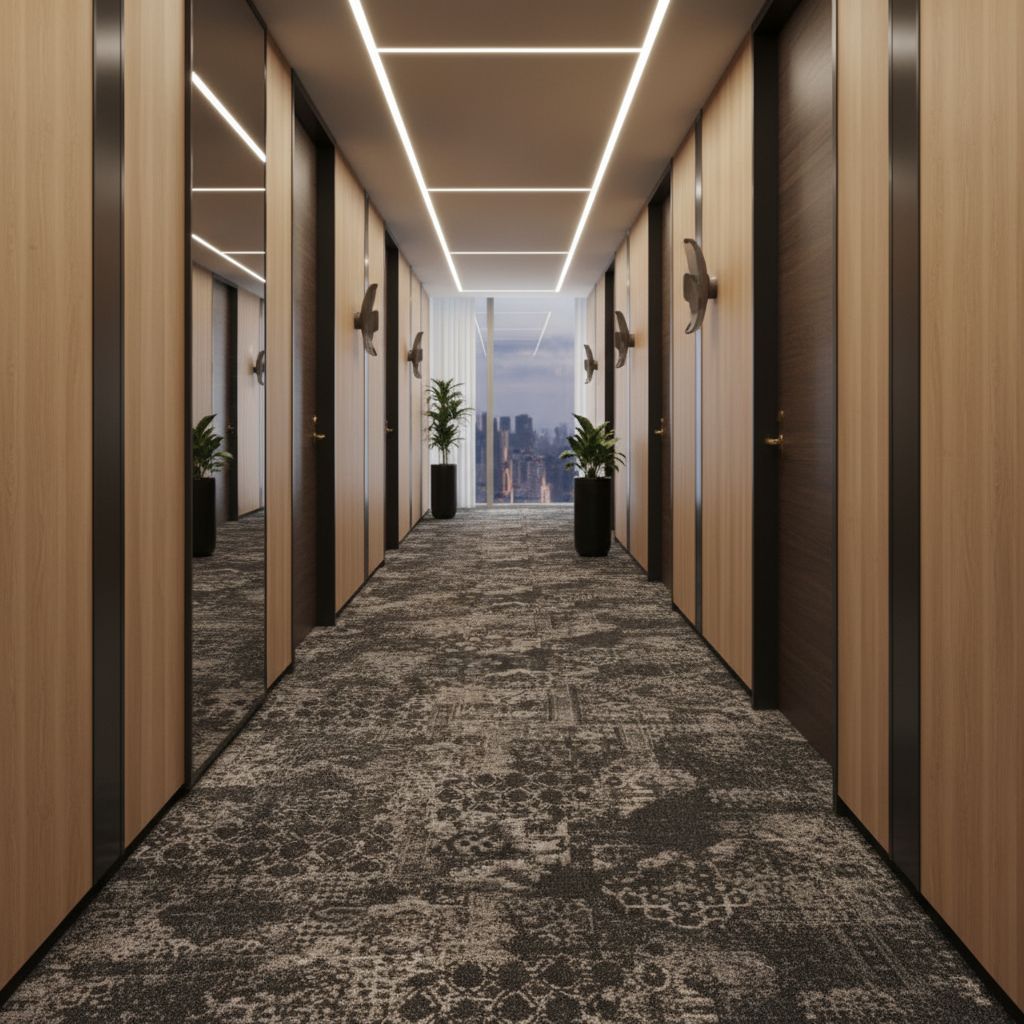
Corridor Carpet: Beyond Beige
 Toronto’s condo market is a machine: thousands of towers, millions of square feet of shared corridors, and a relentless retrofit cycle that quietly shapes the aesthetic DNA of the city. Every seven to 10 years, those corridors are stripped and recarpeted. Multiply that across roughly 2,700 condo corporations, and the result is staggering: nearly 270 to 380 buildings re-carpeted annually, representing $80 to $120 million a year and more than $1 billion per decade.
Until now, nearly every dollar has flowed south. More than 90 per cent of corridor projects rely on solution-dyed ColorPoint carpets from Dalton, Georgia, and 65 per cent of commercial carpet used in Canada originates in the U.S. It’s a monopoly built not on design ambition, but on supply-chain inertia.
Interior designers operating in Canada’s multifamily and retrofit sector know the drill: long rolls, fire and acoustic compliance, durability under wheel-and-foot traffic, and finishes that sit quietly in the background of everyday life. But they also know the dullness of “condo beige” corridors. Enter Matter & Co, a Canadian-owned distributor that is rewriting the script by forging partnerships with European carpet leaders in France (Balsan) and Denmark (Ege). We’re talking wool and recycled fibers produced under strict EU environmental standards, supported by Canadian warehousing, sampling, and project service.
In a multicultural design landscape where hospitality, residential, and commercial aesthetics continually cross-pollinate, the move injects choice, character, and sustainable rigor into a category that has long lagged behind luxury lobbies and amenity zones.
 Why this matters for Canada
Beyond aesthetics, there’s a macro-economic subtext. The current supply chain sends over $100 million per year directly to U.S. mills, a flow of capital that leaves Canadian designers, developers, and condo boards tethered to a single foreign ecosystem. In a climate of unpredictable tariffs and tightening cross-border politics, diversifying supply isn’t just a matter of taste: it’s strategic.
Toronto’s vertical housing experiment is maturing. As condo living becomes a generational reality, common spaces matter. Corridor design — once treated as a utilitarian footnote — is now a site for brand identity, resident experience, and resale value. Affordable luxury in shared circulation zones is no longer a contradiction; it’s the next evolution in multifamily design. For designers, this isn’t just another vendor shift. It may represent a structural disruption in a quiet but massive market. One that starts in the hallway.
Matter & Co wants to keep things local: stock product domestically; support project teams here; and reinvest in Canadian infrastructure while tapping into European technical and creative leadership. We reached out to Lisa Parise from Matter & Co to better understand the origins of this “beige industrial reality” and the value of a global design / Canadian distribution strategy.
Canadian Interiors: Toronto’s condo retrofit cycle represents a massive, recurring design opportunity, yet historically, most corridor carpets have come from a small cluster of U.S. mills. From your perspective, why has this supply chain become so concentrated, and what does diversifying suppliers mean for designers?
Lisa Parise: The condo supply chain in Toronto has become heavily concentrated on American-made products largely because, as the city’s skyline began booming, U.S. carpet manufacturers invested aggressively in Canada. They placed sales teams and brand reps north of the border to secure condo corridor specifications and support their factories back home. At the time, free trade made this cross-border model efficient and cost-effective, and the dominance of American solution-dyed nylon (SDN) production reinforced the trend [with] SDN being the preferred fibre type for condo corridors due to its durability and stain resistance.
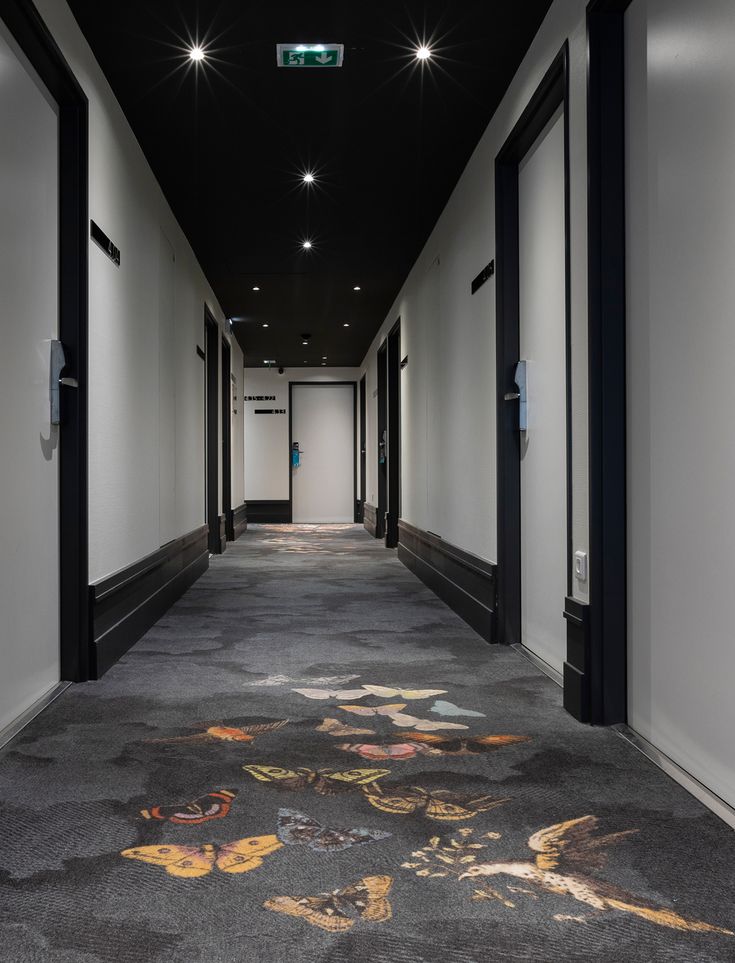
However, while this solved supply and logistics challenges for a growing city, it also narrowed the design palette. Toronto’s design community draws influence from both American modernism and European minimalism, yet the U.S. mills generally offered more conservative, repetitive patterns. The result was a market saturated with similar aesthetics, limited colour stories, and a lack of avant-garde or architectural motifs.
Bringing European factories to the Canadian market has changed this dynamic. European mills—particularly those in France, Denmark, the U.K., and the Netherlands—bring more sophisticated design capabilities, including biophilic patterns, architectural geometrics, woven textures, and broader custom capabilities; more advanced sustainability attributes, as the EU is years ahead of North America in circularity, low-carbon production, EPD transparency, and reductions in chemicals of concern; alternative fibre systems, including regenerated nylon, recycled content, and non-nylon solutions for projects seeking PVC-free or lower-carbon interiors; and a wider aesthetic vocabulary, aligning better with Toronto’s increasingly international design perspective.
CI: You say that European carpets promote higher sustainability benchmarks. What sustainability metrics or material criteria do you think Canadian interior designers should prioritize when specifying corridor carpets for high-density residential buildings?
LP: For high-density residential corridors, Canadian designers should prioritize carpets with low embodied carbon, transparent EPDs, and clean material chemistry (low-VOC, PFAS-free, Red-List–free). Fibre choice matters: wool, regenerated nylon, and recycled-content SDN offer far better sustainability performance than virgin petroleum-based fibres. Designers should also look for PVC-free or recycled backings, strong circularity programs (take-back or recycling), and mills that operate with renewable energy or low-carbon manufacturing. Finally, durability itself is a sustainability metric: carpets with higher tuft density, better backing systems, and easy repairability reduce long-term waste and carbon impact.
CI: Condo corridors balance heavy wear, acoustics, fire-testing requirements, and practical installation formats, but they also shape resident perception and developer brand identity. How should designers evaluate carpets for this dual mandate, and what emerging performance or aesthetic trends should they be watching for in multifamily corridor design?
LP: Designers should evaluate carpets through a dual lens: durability and brand identity. On the performance side, prioritize high-density constructions, strong acoustic ratings, Class A fire performance, and formats that install cleanly in long hallways (tiles, planks, or custom woven Axminster). At the same time, corridors are increasingly seen as an extension of a building’s personality. Designers are moving toward biophilic patterns, organic textures, and earthy palettes for a sense of calm, while others are embracing architectural geometrics and bold colour moments to create boutique-hotel energy. Advances in European patterning and dyeing now allow truly custom storytelling in corridors, letting buildings differentiate themselves while still meeting the heavy-wear demands of multifamily living.
As featured in the January-February 2026 issue of Canadian Interiors magazine.