
According to CSIL’s World Furniture Outlook 2026/2027, in 2025, global trade policy was marked by heightened uncertainty due to shifting tariff policies, geopolitical tensions, and changing trade relationships among major economies.
The report noted that businesses faced challenges in planning investments and managing supply chains due to unpredictable policy changes and the risk of new trade barriers.
The impact of tariffs was smaller than initially expected. Households and businesses front-loaded consumption and investment in anticipation of higher tariffs, giving a temporary boost to global activity early in the year.
Trade flows partially rerouted toward third countries. This also applies to the international furniture trade, which showed almost no growth in 2025, with the effects of tariffs introduced in October becoming evident in 2026. Future prospects are negatively affected by the war in the Middle East, the complex geopolitical situation, and trade policy uncertainty that remains persistently high.
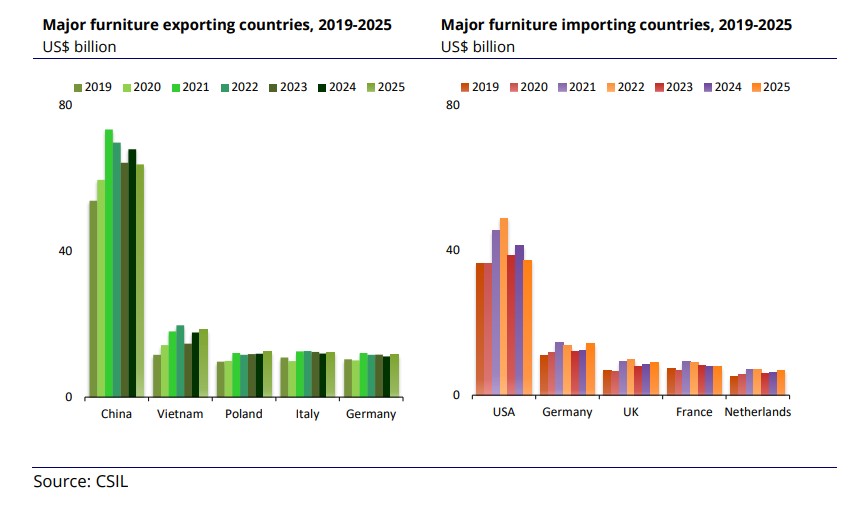 The main furniture exporting country is China, followed at a distance by Vietnam, Poland, Italy, and Germany. In 2025, China’s furniture exports decreased by 6 per cent in current USD. While the United States remained the country’s most important export market, shipments to the U.S. contracted by a double-digit percentage. However, exports to Europe, South America, the Middle East, and Africa increased.
The leading furniture importers are the United States, Germany, the United Kingdom, France, and the Netherlands, which is a trading hub. Over the course of 2025, the U.S. average effective tariff rate for furniture increased. As a result, U.S. imports fell by nearly 10 per cent, and the ratio of imports to consumption decreased by approximately three percentage points. This pattern is not evident globally, suggesting a reconfiguration of trade flows.
The CSIL World Furniture Outlook 2026/2027 report, issued in June 2026, assumes that the international scenario will be as follows:
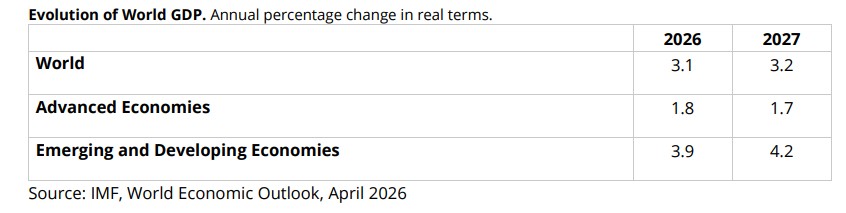 The war in the Middle East and the broader geopolitical landscape are a major concern for the world economy in 2026, with global growth projected to slow to 3.1 per cent even if the conflict is limited in duration.
According to the IMF, downsize risks dominate the outlook. A longer conflict, worsening geopolitical fragmentation, and continuing trade tensions could further weaken growth.
The report noted that renewed pressure on the world economy stems from disruptions to maritime trade and damage to energy infrastructure. Together, these developments have caused a sharp increase in energy and raw material costs, fuelling inflation, weakening sentiment, and slowing household spending and business investment.
Across 100 countries worldwide, after a challenging 2025, furniture consumption is expected to stagnate in 2026 in real terms, with a marginal recovery in 2027.